Posted by Dr. Miguel Fernández Calderón: 29/07/2025
One of the main reasons men seek our consultation is gynecomastia. It is the primary breast condition in men, and causes concern for many. Fortunately, it has a simple and definitive solution: gynecomastia can be eliminated. We are specialists in gynecomastia surgery in Madrid. We work daily with male patients to sculpt their chests in a lean and masculine way.
What is gynecomastia and how does it differ from pseudogynecomastia?
Gynecomastia is the enlargement of breast tissue in men, resulting in the formation of “breasts” similar to those in women. The cause can be hormonal, a result of the consumption of certain medications, or due to certain medical conditions.
Distinguishing between fat and glandular tissue is possible because they are tissues with different densities. True gynecomastia occurs due to an excess of glandular tissue, not fat. Therefore, if you have gynecomastia, you will likely notice a firm lump beneath your areola.
What is pseudogynecomastia?
On the other hand, pseudogynecomastia is characterized by the accumulation of fat in the male chest area, but without development of glandular tissue. If you have gained weight and what you have is fat in the breast area, you will notice them as “soft”. This is known as “false gynecomastia” or “pseudogynecomastia”.
Many times the diagnosis is not easy because there is growth of both fat and glandular tissue. For this reason, it is best to request an assessment with a doctor who specializes in gynecomastia surgery. A plastic surgeon with sufficient experience can detect your problem and provide a solution.
In case of doubt, your surgeon may request an imaging test. The most common is ultrasound. It is a simple, economical, and painless test.
Grades of gynecomastia
Gynecomastia can be classified as:
- Grade I Gynecomastia. It is the mild type localized to the size of the male breast.
- Grade II Gynecomastia. It is of a moderate nature, in which there is a moderate increase in the size of male breasts, which may extend beyond the areola.
- Grade III Gynecomastia. It is the most severe condition, in which the volume of male breasts is considerable, with the presence of significant glandular tissue and fat.
Main causes of gynecomastia
Although much smaller than those in women, men also have breast glands. When they enlarge excessively, gynecomastia develops.
There are many possible causes of excessive breast development. And most of them are due to a hormonal imbalance.
While gynecomastia is a common concern in men, sagging breasts are a concern for women, which can be corrected with a breast lift in Madrid.
Hormonal imbalance
Gynecomastia is more frequent during puberty, when a young person is evolving toward adulthood. Similarly, it is also common to appear around age 50, because at this age there is a decrease in testosterone. These hormonal problems can favor breast development.
Adolescent gynecomastia tends to disappear spontaneously in many cases. This, along with that of maturity (also known as andropause), are the most common causes.
Medications, drugs, steroids, and alcohol consumption
There are other less frequent causes. Sometimes, the use of drugs (marijuana) or medications (steroids) can enhance breast development.
Diseases
Underlying diseases can cause gynecomastia. In patients with liver problems such as those caused by cirrhosis or chronic liver failure, there may be a hormonal imbalance that triggers gynecomastia.
Additionally, the extra X chromosome in those who suffer from Klinefelter syndrome can have breast tissue growth as a symptom, due to an increase in the estrogen/testosterone ratio.
Exceptionally, some hormone-secreting tumors (testicular, for example) cause gynecomastia.
However, we emphasize that these situations are very rare. The most common cause is that breast enlargement is due to a hormonal imbalance, typical of age.
Obesity and sedentary lifestyle
Although gynecomastia is not a product of being overweight or obese, these conditions alter hormonal levels and metabolic health, just as having a sedentary lifestyle does. And this is what contributes to gynecomastia appearing or worsening.
Can gynecomastia be eliminated without surgery?
In adolescents, there is a certain percentage of gynecomastias that disappear over time. Since they are caused by hormonal imbalances, the problem goes away when puberty ends, because the endocrinological balance is restored.
We do not mean to indicate that all adolescent gynecomastias will go away spontaneously. Nothing could be further from the truth. We do not want to give you false hopes, but there are some “temporary gynecomastias”.
Diet, exercise, and weight loss
A healthy diet, having an exercise routine, and losing weight are factors that can help improve hormonal imbalance. Therefore, the patient who suffers from gynecomastia can see improvements in their condition.
Hormonal and pharmacological treatments
Some types of gynecomastia may respond to medical treatment. This means that with medication, they can disappear. Or, at the very least, the size of the breasts can be reduced. Since gynecomastia occurs due to an excess of female hormones, treatment involves blocking these hormones with a medication called tamoxifen. It must be taken for an extended period over several years.
Complete disappearance of gynecomastia can occur in more than 50% of cases. However, there is a possibility of recurrence after stopping the medication.
Furthermore, it has no effect when gynecomastia has already been established for months. The advantage of tamoxifen is that it can slow breast growth and reduce discomfort.
Limitations of non-surgical methods
Gynecomastia surgery is the best option when, after months of development, gynecomastia has not disappeared. It is the definitive solution for established glandular nodules in the chest.
In summary, there is no need to rush into gynecomastia surgery as soon as it is detected in a young man. The most sensible approach is to wait 1 or 2 years to determine whether it is something temporary or not. During that time, treatment with tamoxifen can be an alternative.
If, after some time, the nodules remain, this surgery for men is the only solution.
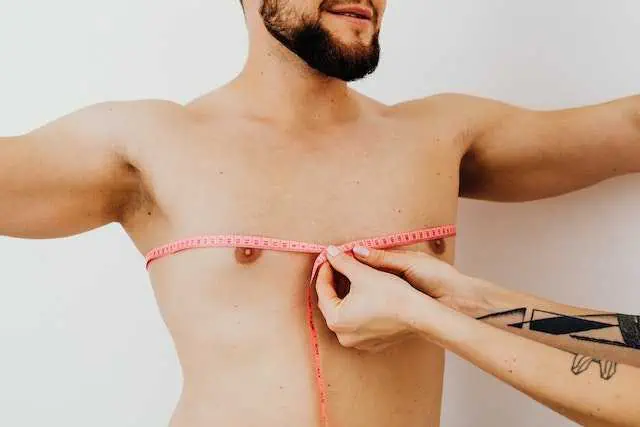
Surgical treatments to eliminate gynecomastia
In recent decades, plastic surgery has evolved to offer the best possible results. Techniques are increasingly less painful and safer. Gynecomastia surgery is no exception to this trend. Today there are numerous techniques available to correct this condition.
Before choosing one of them, your surgeon must examine your breasts. To make a decision about the surgical technique, he will evaluate several aspects of your chest: excess skin, excess fat, and nipple sagging (ptosis).
Liposuction for pseudogynecomastia
In the case of false gynecomastia, the patient will have an accumulation of fat in the pectoral area that can be effectively removed with liposuction. During liposuction, fat deposits that form male breasts are extracted. This procedure is minimally invasive, leaving small scars and allowing for quick recovery, with noticeable results that improve the appearance of the chest, giving it a more defined and flat appearance.
Subcutaneous mastectomy or glandular excision
The simplest scenario occurs in breasts with minimal excess skin, well-defined nodules, and a properly positioned nipple. In this case, the surgery will be based on creating a scar in the lower half of the areola. Through this incision, the gland will be removed.
In breasts with moderate excess skin and a somewhat drooping nipple, it is necessary to reposition the nipple. Gynecomastia surgery will be performed through a circumferential incision. The scar will be around your entire areola. This way the nipple will take on an aesthetically acceptable position, and excess skin will be removed.
In breasts with significant excess skin and the nipple positioned well below normal, more extensive scars are necessary. Inverted T-shaped scars may be required. This involves a horizontal scar, a vertical one, and another circular one around the areola. Or a horizontal scar and a nipple graft may be necessary.
However, gynecomastia surgery with extensive scars is exceptional. The most common approach involves small scars around the areola.
Combination of liposuction and excision
In cases where there is fat around the breast, the surgery can be accompanied by liposuction. This procedure allows us to sculpt the torso to achieve the most masculine shape possible. It also facilitates complete removal of the gland.
Can gynecomastia return after surgery?
Yes, but it is very unlikely. Gynecomastia surgery typically resolves the problem in the vast majority of situations.
After surgery, it is possible that if you gain significant weight, the size of your breasts may increase. In this case, your doctor should examine you. If it is only due to an increase in fat, the solution will be straightforward: Lose weight.
You should know that it is impossible to completely eliminate all glandular tissue. Some will always remain. In some situations, fortunately rare ones, the remaining gland tissue may grow excessively. Then you might notice gynecomastia again. This is very uncommon. It usually occurs in people who take anabolic steroids.
Which surgeon is best for gynecomastia?
There are different types of gynecomastia, and each patient is different and unique. For this reason, it is so important to know all surgical techniques and employ the most appropriate one.
At Sculpture Clinic we have a team of specialists in gynecomastia surgery. We perform this type of operation weekly, so we have extensive experience. Furthermore, we possess the most advanced liposuction and skin tightening technology to provide you with spectacular results.
At our clinic we will examine your condition and develop a treatment plan according to your needs. If your goal is to achieve excellent results from your gynecomastia elimination surgery, book your free assessment with our team.