Blog of News, Tips and Aesthetic Care
Every patient hopes to achieve the best results after an aesthetic procedure. However, it is important to understand the risks involved. In this article, we will discuss skin irregularities after liposuction. What are they? Can they be prevented? Keep reading and discover what you can do to avoid these issues.
Liposuction is an aesthetic procedure that allows the removal of localized fat from different areas of the body. For example, the abdomen, hips, thighs, or arms. In this way, you can eliminate fat that, due to its characteristics, is difficult to remove with traditional methods.
Liposuction only removes fat; if excess skin also needs to be removed, the appropriate option is to combine it with an abdominoplasty. Although they are two different surgeries, they complement each other.
Over the years, liposuction has become more effective. It is an invasive procedure, but with accurate diagnosis and precise technique, it does not present major health complications for the patient.
Liposuction techniques have evolved over the years and different methods have been developed to remove excess fat. Among the most common are the following:
To choose the best liposuction technique, various factors must be considered, such as surgeon preferences, patient needs, and the areas to be treated.
The surgeon will help select the most appropriate method based on your goals and overall patient health. They should also consider irregularities such as cardboard-like skin after liposuction to prevent them from occurring.
Liposuction is especially indicated for healthy people, and should not be a substitute for a healthy diet and frequent exercise.
If you want to guarantee good aesthetic results and avoid skin irregularities after liposuction, you must meet a series of basic requirements.
The main requirements to be a candidate for liposuction are:
These factors are key to achieving the desired result and avoiding scars on our body. Accurate diagnosis and assessment of the patient’s health status are decisive for everything to go well. It is also important to assess how much fat can be removed without compromising skin quality.
Yes, it is common to observe skin irregularities during liposuction recovery. Your body goes through several healing stages that can temporarily affect how your skin appears. Afterward, you will have smooth contours.
In the first weeks and months following liposuction, it is expected that the treated area will not feel perfectly smooth. These are normal temporary irregularities.
Swelling is normal in the first weeks. Later, you may feel hardened areas or cords beneath the skin. You might also notice certain visible waves when adopting specific postures while your skin recovers its elasticity.
Most of these irregularities disappear during recovery. However, there are warning signs that your skin is not evolving properly and that you require medical attention.
For example, if you notice a lump that feels like a water sac or clear fluctuation under the skin that does not decrease with compression garments. Also if highly localized, hard, and even painful lumps appear.
If the irregularity is accompanied by warmth, redness, throbbing pain, or fever, it may indicate an infection. Likewise, if you notice marked asymmetries caused by the cannula, or after 6 months if you see deep linear grooves.
There are certain factors that, if not taken into account, can produce skin irregularities after liposuction. Below, we will review the possible complications that may arise.
These can appear when the skin does not contract properly after liposuction.
If the patient presents a high degree of overweight or obvious lack of skin elasticity before the procedure, it is very likely that folds and depressions will remain in the treated area. This occurs when the extracted fat leaves a large void and the skin has little capacity to adapt to this new empty space created.
Loss of skin elasticity is a problem aggravated by two factors: age and sudden weight changes. This can cause asymmetries in our silhouette that, logically, may be worsened by this procedure, which can generate the effect of wrinkled skin after liposuction.
Another type of risk that may appear after this operation is the presence of seromas (accumulation of body fluids) in the treated area and beneath the skin. This occurs especially if we do not properly use compression garments and lymphatic drainage during the postoperative period.
When too much fat is extracted from an area, depressions in the skin may appear. The risk is even greater if the patient has poor skin elasticity.
Color changes may also occur, such as brown or red spots. To prevent this from happening, it is important to care for your skin as directed by your physician and avoid sun exposure while scars heal.
These manifest as areas of skin that feel hardened, like bumps or knots to the touch. This occurs as a result of internal scarring of tissues treated with the cannula.
The body fills that empty space between the skin and muscle with collagen and fibrous tissue. If too much is produced, these nodules form. They typically appear between the second and fourth week after surgery.
The idea that the human body is completely symmetrical is a misconception; there are always certain differences, which may be temporarily or permanently accentuated after surgery.
It may happen that one side of the body deflates faster than the other, also because the skin does not shrink at the same rate in all areas.
It is usually advisable to wait about 6 months to assess true asymmetry.
You may also wonder why your skin itches after liposuction. It is normal for this to occur while scars heal and your skin recovers. Therefore, there is no need to worry, and you should keep your skin hydrated. If it is excessive, consult with your surgeon.
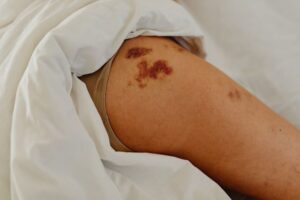
There are different main reasons why skin irregularities may appear after liposuction:
If too much fat is removed, the skin may not have sufficient elasticity to adapt.
People with thinner skin or lower elasticity are more likely to develop irregularities. This is why the surgeon’s prior assessment is so important.
Some liposuction methods may be more prone to causing irregularities than others. It is important to evaluate which is most appropriate for each case.
The specialist you choose should have experience in liposuction; in this way it is more likely to produce satisfactory results.
Failing to follow the surgeon’s instructions after liposuction can result in skin irregularities.
It is likely that irregularities will resolve on their own over time. However, in some cases they require an additional procedure to correct them.
Preparation for liposuction in Madrid is essential to ensure the quality of your final results.The first recommendation is to carefully select the medical team that will perform your procedure. This ensures not only a smooth surgery without complications, but also proper postoperative care.
The most important measures to take before surgery are:
After your procedure, it is very important to follow these recommendations to improve skin firmness:
Correcting irregularities depends on the time elapsed since surgery and the specific cause of the problem.
There are non-invasive treatments available during the first 6 months, such as lymphatic drainage, radiofrequency, pressotherapy, shock waves, or carboxytherapy. These help support healing and reduce inflammation, allowing the skin to settle properly.
After 6 months, once inflammation has subsided, you may consider hyaluronic acid fillers, for example.
If irregularities are very pronounced one year after surgery, after consulting with your surgeon, you could consider revision surgery.
All these measures are only possible with a skilled team of professionals committed to your health as well as your aesthetic goals.At Sculpture Clinic, we specialize in body plastic surgeryand we put our professional team at your service to achieve the results you desire.
References:
Together we are stronger
Plastic, reconstructive and aesthetic surgeon
Anesthesiologist
Plastic, reconstructive and aesthetic surgeon
Uncategorized
Sin categorizar